An operating system for marketing and sales.
Not another tool, but the framework around them: a shared picture of the situation, a prioritised task list with named owners, a fixed measurement method – and a lasting record of the work and decisions. Here you can see what that looks like from the inside. Including what didn’t work.
All figures come from an anonymised real business: a B2B service provider with nine employees. Each figure is dated.
Marketing rarely fails for lack of ideas. It fails because too little is sustained over time.
Knowledge is stored in people’s heads and scattered across separate tools. Anyone who made a change last week still remembers it; three months later, nobody does. A useful action gets agreed twice but never completed. And when someone is away, the process stops with them.
A system keeps a lasting record of four things: what currently applies, what is outstanding and who is responsible for it, how success is measured – and mistakes that have been made before.
- Seewhere you stand: search data, website, market, enquiries – measured, not estimated
- Decideyou – with supporting evidence, a goal, a metric and a review date
- DoAI prepares, you approve
- Reviewdid it work? One page every Monday, one report every month
What the follow-up measurements reveal becomes the starting point for the next round. The real work is closing the loop so that what went wrong last time informs what happens next. Lessons from each wrong turn are recorded as rules to reduce the chance of it happening again.
One sets the direction. The other does the work and measures the results.
What is said – and why
Positioning, target customers, message and topics. These decisions require human judgement and remain yours. MarkKi provides the metrics, templates and probing questions to support them.
How it is published or sent out
Building, updating and checking pages, preparing posts, researching target customers and measuring impact. Today, most of this work is automated. You decide what appears; the system handles how it gets there.
With only the second engine, you simply publish irrelevant content more quickly. With only the first, you have good ideas but a public presence that feels years out of date.
A portal in the browser. Each role has its own home page.
You sign in with your own account and see what is relevant to your work: an overview of the situation, the prioritised task list and the tools. Target customers and the editorial plan are managed there; reports, decisions and instructions are kept in a searchable library.
The overviews are generated from the source data. Where information is still entered manually, a monitoring check ensures that everything stays in sync. This helps identify inconsistent data and conflicting analyses.
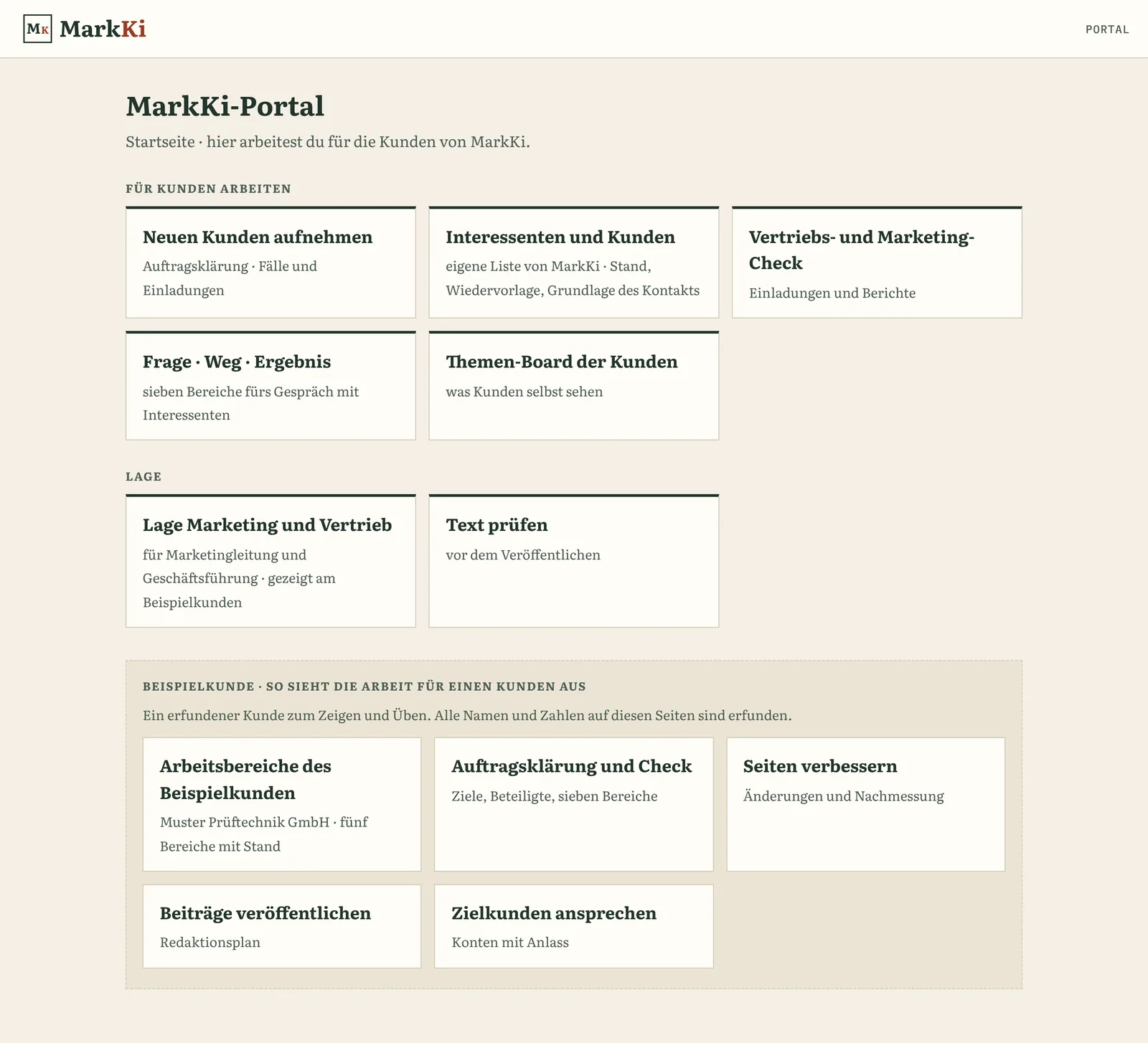
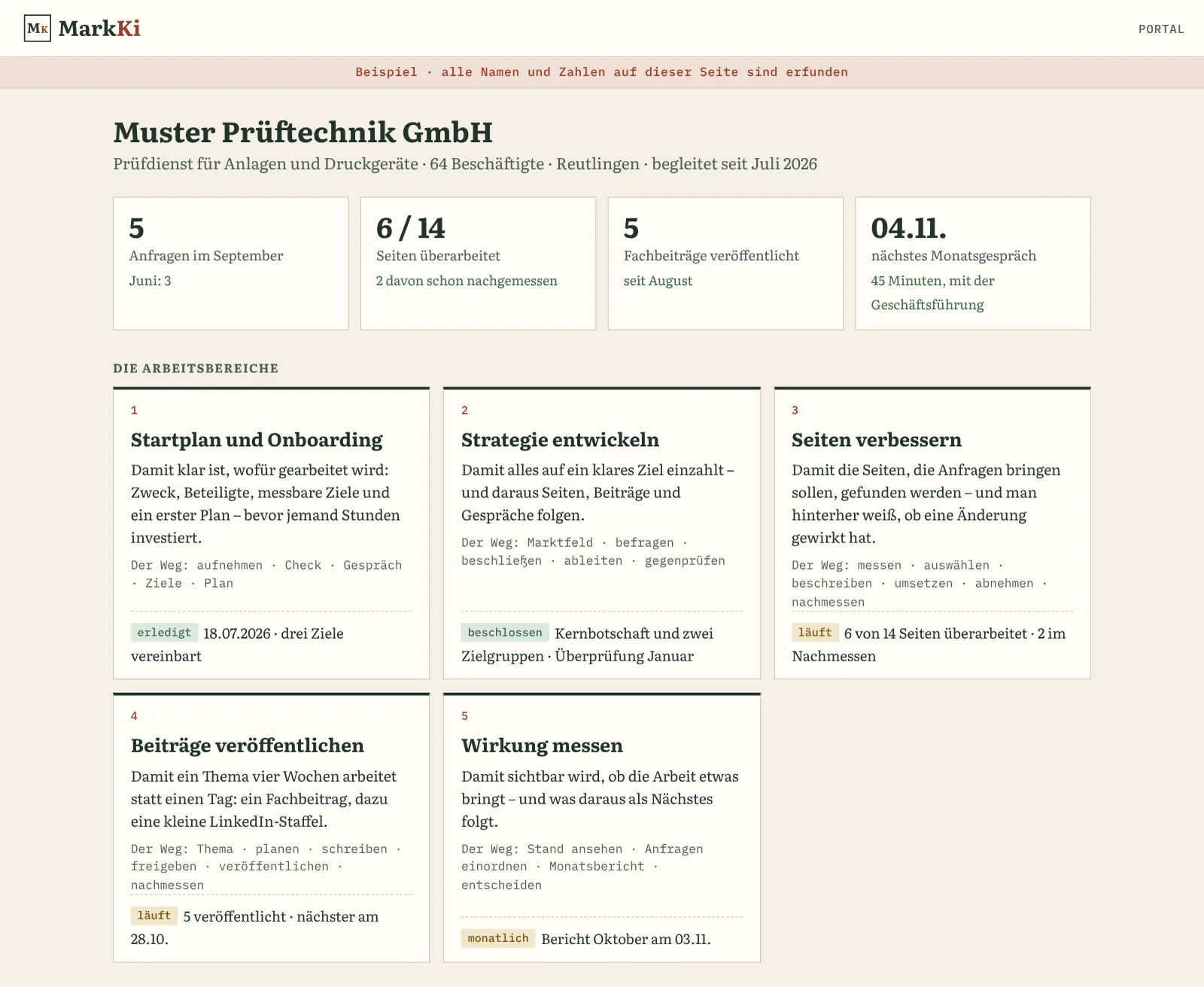
Four figures from the business. And one that didn’t grow.
The figure that didn’t grow
Over three months (17 May to 16 August 2026), there were 18 clicks from 48,720 impressions for searches that did not include the company’s name. One specialist search term ranked second and received 612 impressions but not a single click: an AI-generated answer appeared above it.
This figure appeared exactly as shown in the monthly report to management. Reporting that only shows successes is little more than a sales brochure. Only an honest baseline makes it possible to decide what to do next. In this case, the measure of success was changed from search rankings to clicks and enquiries.
A customer cites a sentence on the website.
A real incident from 29 July 2026, anonymised. The wording was not intended to mean that, but the customer used it as the basis for a claim.
- Morning. A package of corrected wording is ready for approval.
- Before implementation. The mandatory check against the published version revealed a flaw in our own proposed changes: one of the three locations was just a redirect, and a fourth, clearer version appeared in a more prominent position without anyone knowing about it.
- Afterwards. All 203 pages were checked against the same pattern. No further instances were found. Time taken: two minutes.
- Implementation. Four locations were corrected, with the visible wording and the underlying machine-readable version made identical in each case.
- Close-out. The decision becomes a rule and the mistake becomes a lesson; the contractual issue is explicitly left unresolved.
The point is not the speed. It is that we challenged our own earlier work rather than simply trusting it.
Three levels, honestly assessed.
‘We can do this’ means it is in day-to-day use and backed by evidence. ‘Partly’ means it has been built, but there is an identified gap. ‘Still open’ means it is not yet available.
| Level | What | How you can check it |
|---|---|---|
| We can do this | Situation overview, prioritised task list, monthly report, building and checking pages, preparing specialist articles and LinkedIn posts | dated reports and test records in the portal |
| We can do this | Turning mistakes into rules | 384 lessons, each recording what prompted it and the date (as at 4 October 2026) |
| Partly | Fully automated runs: the weekly process and monthly report have been completed from start to finish without human intervention since late September 2026 | so far, one complete run of each – a single run, not a series of results |
| Partly | Approaching target customers: profile, research and reason for contact are in place; the texts are on hold | whether this leads to new customers has not been measured |
| Still open | Which enquiry came from which page | the attribution is missing |
| Still open | Managing ads: the process is in place but has not yet been carried out from start to finish | case not yet completed |
The honest caveat: the system does not do anyone’s thinking for them and does not replace any decision. Every company needs a person who leads it. And the first honest measurement shows first of all what isn’t working. You should know both before you start.
The substance lies in the processes behind it.
Review frameworks, wording guidelines and catalogues of known errors have been developed through day-to-day work and are deliberately not reproduced here. What you see is the result: what the system looks like, what it delivers and how you can tell whether it works.
None of it was planned. Almost every component began as a response to a specific practical problem. That is why others can follow the same approach without needing to know in advance where it will lead.
Start with the Sales and Marketing Check